

Meet Ananya
Ananya is twenty-four. She works in a multinational company, enjoys her job, and is generally considered healthy. Her annual health check-up is mostly normal, and her doctor reassures her that there is nothing to worry about.
Yet she doesn’t quite feel healthy.
Her mornings begin with coffee because there is no time for breakfast. Lunch is usually ordered through a food delivery app and often arrives in plastic containers. She drinks bottled water through most of the day, rarely wondering how long the water has remained inside the plastic bottle before reaching her hands.
Before leaving for work she spends nearly an hour getting ready. Moisturizer, sunscreen, foundation, perfume, deodorant, lipstick, hair serum - products she has trusted for years because they are sold by reputable brands.
She slips into wrinkle-free synthetic office wear that hardly needs ironing, wears comfortable polymer-soled shoes, and spends nearly eight hours surrounded by computers, air-conditioning, synthetic furniture, and artificial lighting.
Her evenings end with packaged snacks, another bottle of water, and hours of scrolling on her phone before finally sleeping well past midnight. She wakes up late, skips breakfast again, and repeats the cycle.
Every month she struggles with painful menstrual cramps. Her skin breaks out with persistent acne despite trying different skincare products. Some weeks she feels unusually irritable; on others she is simply exhausted for no obvious reason.
Nothing in Ananya’s life appears dramatic. There has been no serious illness, no single event that explains her symptoms.
And yet, one cannot help asking a simple question.
Could health be influenced not only by diseases we acquire, but also by the countless small exposures we accumulate every single day?
Modern environmental medicine believes the answer is yes.
The Age of Invisible Exposures
When we hear the word poison, we usually imagine something immediate - a snake bite, cyanide, or arsenic. Poison, in our minds, is something that acts quickly and dramatically.
The greatest toxic challenge of the twenty-first century, however, rarely arrives that way.
Instead, it comes quietly through pesticide residues on vegetables, plastic chemicals leaching into drinking water, air pollutants inhaled during the morning commute, food additives, cosmetic ingredients, heavy metals, pharmaceutical residues, and countless industrial chemicals that have quietly become part of everyday life.
Modern science calls these foreign substances xenobiotics. The word simply means “foreign to life.” Not every xenobiotic is harmful; medicines are xenobiotics too. The concern begins when exposure becomes continuous, when several exposures occur together, or when the body’s ability to metabolize and eliminate them is overwhelmed.
This realization has transformed the way scientists think about health. Increasingly, they no longer study isolated chemicals alone. Instead, they study what is known as the exposome - the sum total of all environmental exposures a person experiences from conception until death. It includes chemicals, diet, pollution, medications, infections, stress, occupation, and lifestyle, all interacting continuously with our biology.
Notice how different this question is from the traditional idea of poisoning.
Medicine is no longer asking, “What poison entered the body?”
It is asking, “What has this body been exposed to throughout its lifetime?”
As I was reading about the exposome, I found myself wondering whether Ayurveda had ever looked at health through a similar lens.
How Do Toxins Behave?
When Ācārya Vāgbhaṭa discusses toxins in the Aṣṭāṅga Hṛdaya, he begins not by listing poisonous plants or venomous animals, but by describing the very nature of poison.
तीक्ष्णोष्णरूक्षविशदं व्यवाय्याशुकरं लघु ।
विकाषि सूक्ष्ममव्यक्तरसं विषमपाकि च ॥(Aṣṭāṅga Hṛdayam Uttarasthāna 35/6)
He says that poison is penetrating (tīkṣṇa), hot (uṣṇa), drying (rūkṣa), non-unctuous (viśada), rapidly spreading throughout the body (vyavāyī), quick acting (āśukārī), light (laghu), capable of loosening tissues (vikāśī), subtle enough to enter minute channels (sūkṣma), often imperceptible in taste (avyakta-rasa), and difficult to digest or metabolize (viṣamapākī).
What struck me while learning this description is that Ācārya Vāgbhaṭa is less interested in what poison is than in how poison behaves inside the body.
Many modern environmental contaminants behave in a surprisingly similar manner. They cross biological membranes, travel through the bloodstream, enter tiny tissues, cross the placenta, accumulate in fat, interfere with hormones, and resist complete metabolism.
When Toxins Don't Leave
Among the many concepts in Ayurvedic toxicology, Dūṣī Viṣa perhaps resonates most strongly with today’s understanding of chronic environmental exposure.
Ācārya Vāgbhaṭa describes Dūṣī Viṣa as poison that has lost much of its original potency. Time, sunlight, wind, heat, or even antidotes may have weakened it. Yet it has not disappeared. It remains concealed within the body, often under the cover of Kapha, sometimes for years.
What is even more remarkable is that Dūṣī Viṣa does not produce disease continuously. It waits.
It becomes active when digestion is disturbed, when incompatible foods are consumed, during certain seasons, after exposure to cold or wind, or when the body’s resilience declines.
प्राग्वाताजीर्णशीताभ्रदिवास्वप्नाहिताशनैः ।
दुष्टं दूषयते धातूनतो दूषीविषं स्मृतम् ॥(Aṣṭāṅga Hṛdayam Uttarasthāna 35/36)
This is a profound clinical observation.
The problem is no longer the poison alone. The problem is the persistence of exposure and the body’s changing ability to deal with it.
Modern toxicology has arrived at a similar concern. Many environmental contaminants are not acutely poisonous. Instead, they remain within adipose tissue, bone, liver, or other compartments for prolonged periods, quietly interacting with immunity, metabolism, endocrine function, and inflammatory pathways.
Is it one exposure - or all of them together?
At this point, let us return to Ananya.
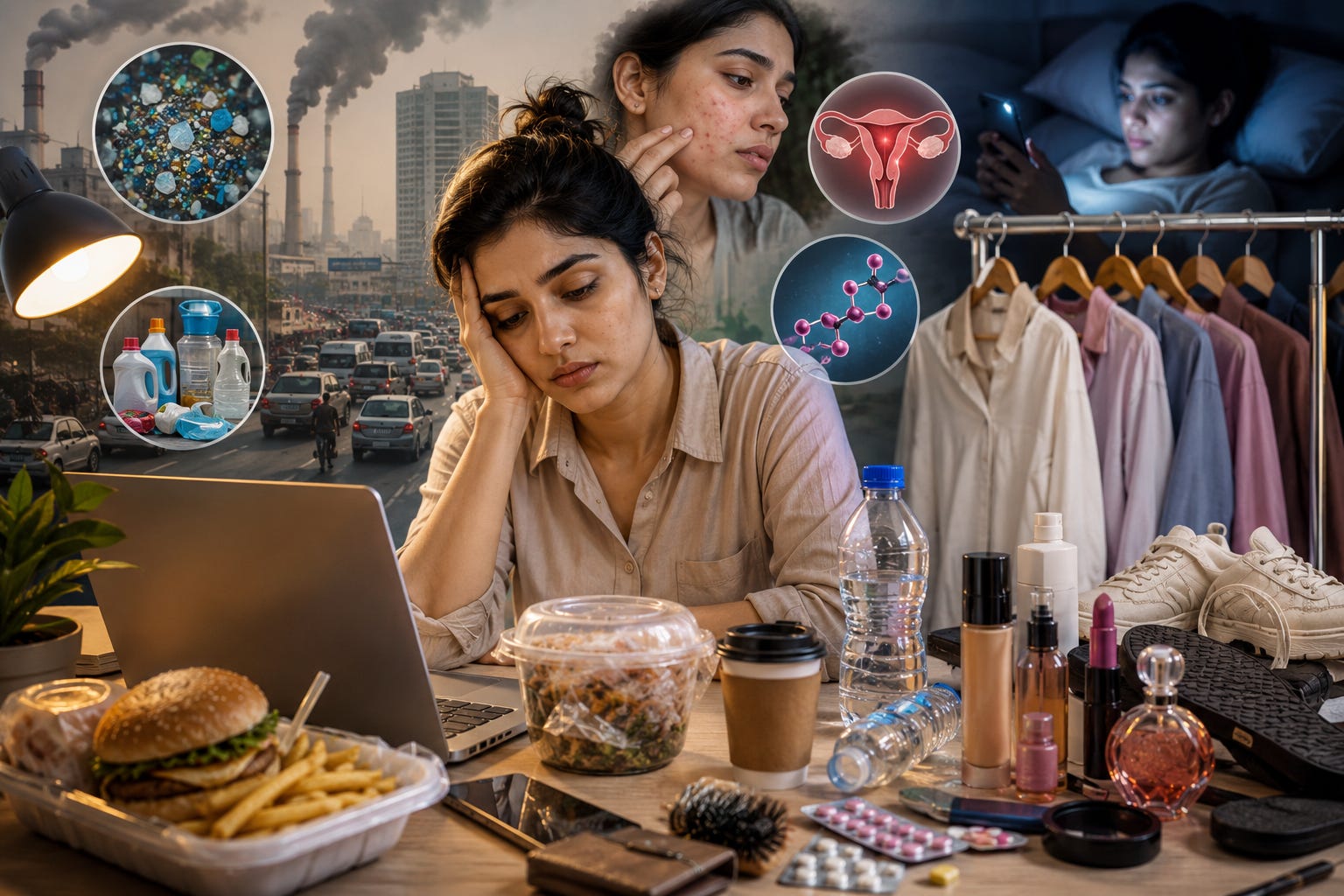
Was it her perfume that caused her acne? Probably not.
Was it the processed food? The lack of sleep? The cosmetics? The repeated use of plastic food containers? The chronic stress? The irregular meals? Probably not.
Could it be that none of these, in isolation, explains her symptoms - but together they gradually create a biological burden?
Modern environmental medicine would describe this as the cumulative effect of the exposome.
Ayurveda might ask a different question. Has repeated exposure, combined with weakened Agni, inappropriate lifestyle, disturbed daily rhythms, and impaired elimination, created the conditions for something resembling Dūṣī Viṣa?
The question itself is more important than the answer.
When Combinations Become Toxic
Another fascinating Ayurvedic concept is Gara Viṣa.
Unlike naturally occurring poisons, Gara Viṣa is an artificially prepared poison produced by combining substances that are individually harmless or only mildly harmful but collectively toxic.
This idea feels remarkably relevant today.
Human beings are rarely exposed to one chemical at a time. Instead, we live amid mixtures - food additives, pesticide residues, plasticizers, heavy metals, pharmaceutical residues, cosmetic ingredients, and air pollutants, all interacting simultaneously.
Modern toxicology now devotes increasing attention to mixture toxicity, often called the cocktail effect, because the biological effects of combinations cannot always be predicted from studying individual chemicals. Sometimes the interaction between substances matters more than the substances themselves.
Why Does the Same Exposure Affect People Differently?
Perhaps the greatest insight offered by Ayurveda is that exposure alone does not determine disease.
Ācārya Vāgbhaṭa speaks of conditions that aggravate Dūṣī Viṣa - poor digestion, day sleep, cold weather, incompatible food, seasonal changes, exhaustion, grief, and disturbed physiology. He even describes a Viṣa-saṅkaṭa, a critical period in which constitution, season, food, doṣas, tissues, and mental state together increase the potency of poison.
Modern medicine says something remarkably similar, although in a different language. Genetics, nutrition, gut microbiota, hormones, stress, sleep, immune function, and metabolism all influence how a person responds to environmental exposures.
Ayurveda speaks of Agni, Prakṛti, Doṣas, Dhātus, Srotas, and Ojas.
Different words. A similar systems perspective.
Helping the Body Let Go
One of the most encouraging findings from modern research is that exposure can be modified. Simply replacing packaged foods with freshly prepared meals significantly reduces urinary BPA and phthalate levels. Organic diets have been shown to markedly lower pesticide metabolites in children. Likewise, modern detoxification science increasingly emphasizes healthy digestion, bowel function, liver metabolism, bile flow, sweating, and a balanced microbiome.
Interestingly, Ācārya Vāgbhaṭa's treatment of Dūṣī Viṣa begins not with an antidote, but with snehana (therapeutic lubrication of the body), svedana (therapeutic sweating), followed by vamana (emesis) and virecana (purgation). Only then does he administer medicines. The therapeutic logic is beautiful: before attempting to neutralize what remains, first help the body mobilize and eliminate it.
From Toxins to Exposure
As Ananya finishes describing her acne, painful menstrual cramps, and persistent fatigue, she expects the Ayurvedic physician to prescribe a cream, a few tablets, or perhaps a tonic.
Instead, he smiles and asks a different question.
“Tell me about your day.”
She begins talking about her meals, her sleep, the food she orders, the bottled water she drinks, the cosmetics she uses, the synthetic clothes she wears, the late nights, the stress she carries, and the rhythm of her life.
Perhaps that is where Ayurveda has always been different.
It begins not with the disease, but with the person. Not with a diagnosis, but with the person - with a life.
Long before the language of environmental health introduced terms such as xenobiotics and the exposome, Ayurveda recognized that health is shaped by a continuous interaction between the body and its environment. What we eat, how we eliminate, what we breathe, what we apply to our skin, the seasons we live through, our daily habits, our mental state, and our digestive capacity all become part of this ongoing dialogue.
This does not mean that Dūṣī Viṣa is the same as xenobiotics, or that Gara Viṣa is simply another name for chemical mixtures. These concepts arise from different systems of knowledge, each with its own language and philosophy. Drawing a direct equivalence would diminish both.
Yet, placing them in conversation reveals something deeply interesting.
Modern science is gradually moving away from searching for a single offending chemical and towards understanding the cumulative burden of lifetime exposures. Ayurveda, through concepts such as Dūṣī Viṣa, Gara Viṣa, Agni, and Viṣa-saṅkaṭa, reminds us that the body’s response to those exposures is equally important. Disease is rarely the consequence of one isolated event. More often, it emerges from countless small encounters, accumulated over time, interacting with an individual’s unique capacity to adapt, transform, and eliminate.
Perhaps that is the real bridge between these two worlds. Both invite us to ask a wiser question.
Instead of asking, “What poison caused this disease?” perhaps we should begin asking,
“What has this person been exposed to, and how has the body responded?”
Sometimes, the answers are found not in a laboratory report, but in the ordinary details of everyday life.
And perhaps that is why, even today, the most important question in an Ayurvedic consultation remains the simplest one:
“Tell me about your day.”
"Tell me about your day" - a talk with my mom every evening as I remember during my childhood...
Ayurveda does indeed cares with a mother's love...